What is a 24/7 lead response system
A 24/7 lead response system is a set of tools and rules that capture every inquiry, send an appropriate acknowledgment, and organize it for follow-up, regardless of the time it arrives. It is not a call center staffed around the clock. It is a structured process built on software.
Here’s what it typically includes:
- Always-on lead capture: forms, chat widgets, and phone systems that work at 2 a.m. the same as they do at 2 p.m.
- Automated acknowledgment: a text, email, or chat reply confirming the inquiry was received.
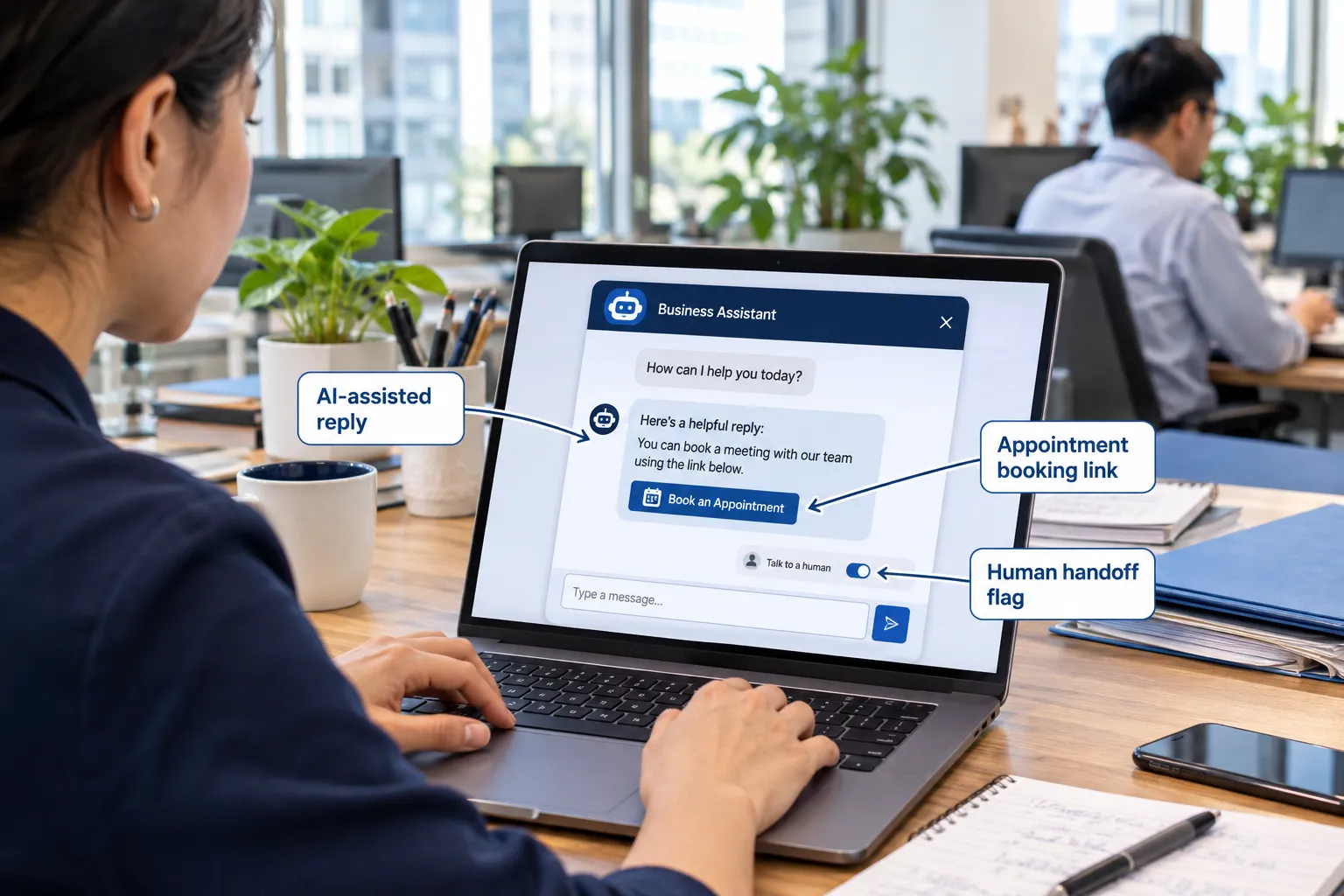
- AI-assisted conversation: a bot that can answer basic questions and collect details.
- Appointment booking: a calendar link so the prospect can schedule a call without waiting.
- Human follow-up: a real person who picks up the inquiry once the business reopens or during on-call hours.
The system’s job is simple: never let an inquiry sit in silence. We build this exact structure inside SalesHubHQ, so leads are captured and nurtured automatically from the moment someone reaches out, whether that’s noon on a Tuesday or midnight on a Saturday.
Why do people submit inquiries outside business hours
People reach out after hours because that’s when they finally have time to think about a purchase, not because they expect an immediate answer from a person. Evenings, weekends, and holidays are when many consumers and business buyers do their research and make decisions.
Common reasons include:
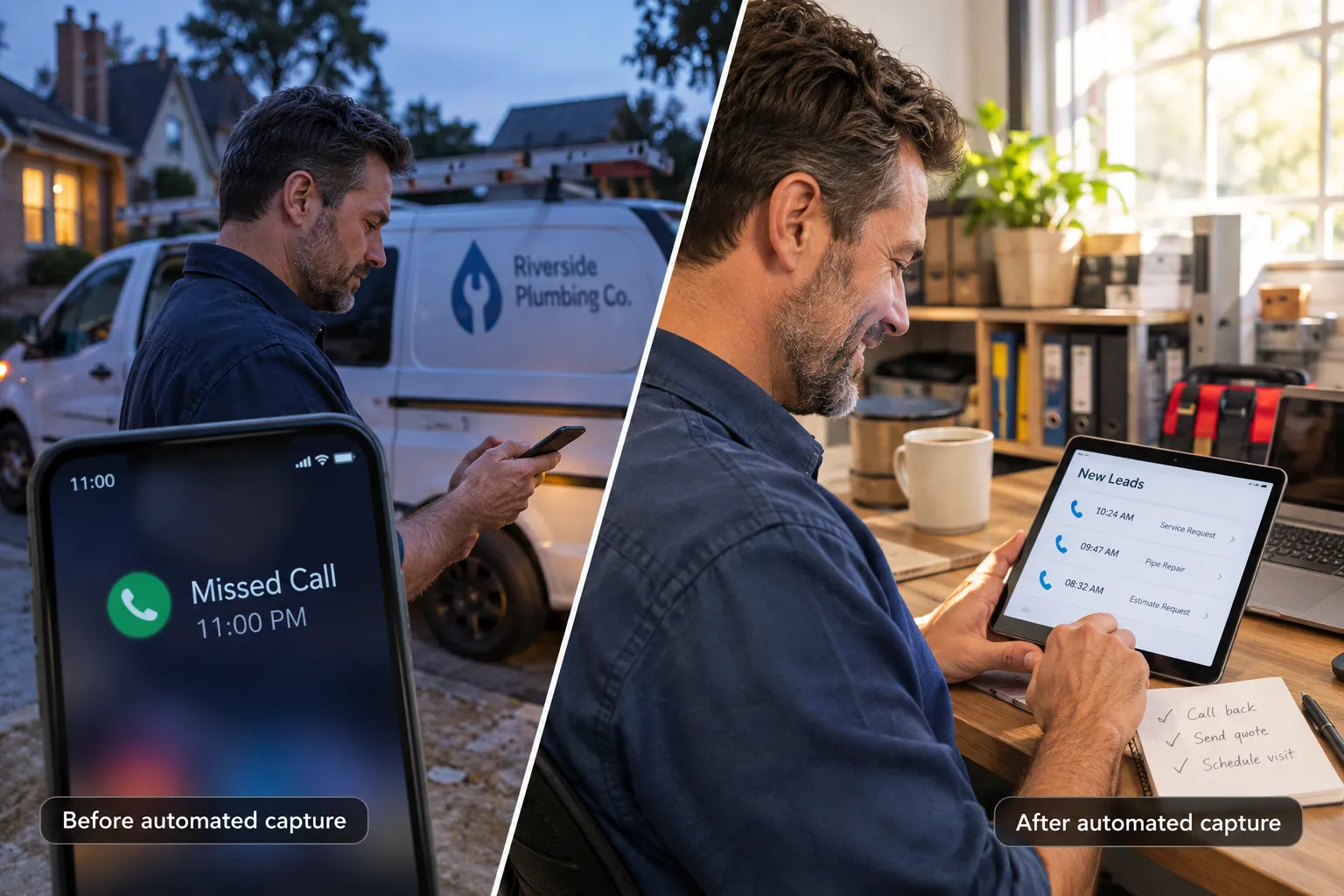
- A homeowner notices a leak at 9 p.m. and starts searching for a plumber right then.
- A B2B buyer finishes a budget review late at night and fills out a contact form before bed.
- A prospect compares three vendors on a Sunday afternoon when they aren’t being pulled into meetings.
- Someone in a different time zone is simply operating during what feels like normal business hours to them.
Edge case: urgent needs, like a broken HVAC system in winter, behave differently than routine research inquiries. Urgent needs need faster routing, even if it’s still automated at first.
Always-available capture vs. automated acknowledgment vs. AI conversation vs. booking vs. human support
These five layers each do a different job, and confusing them is the most common mistake we see. Lead capture collects information. Acknowledgment confirms receipt. AI conversation answers questions. Booking schedules time. Human support actually solves the problem.
| Layer | What it does | What it can’t do |
|---|
| Lead capture | Collects name, contact info, inquiry details | Answer questions |
| Automated acknowledgment | Confirms the message was received | Give specific advice |
| AI-assisted conversation | Answers common questions, qualifies urgency | Replace judgment on complex issues |
| Appointment booking | Lets the prospect pick a time | Resolve the issue itself |
| Human follow-up | Actually solves the problem or closes the sale | Happen instantly unless staffed live |
Decision rule: choose AI-assisted conversation if your inquiries follow predictable patterns (pricing questions, service areas, scheduling). Choose live after-hours staffing only if your business genuinely has emergency-level needs, like fire or water damage restoration.
A realistic after-hours workflow
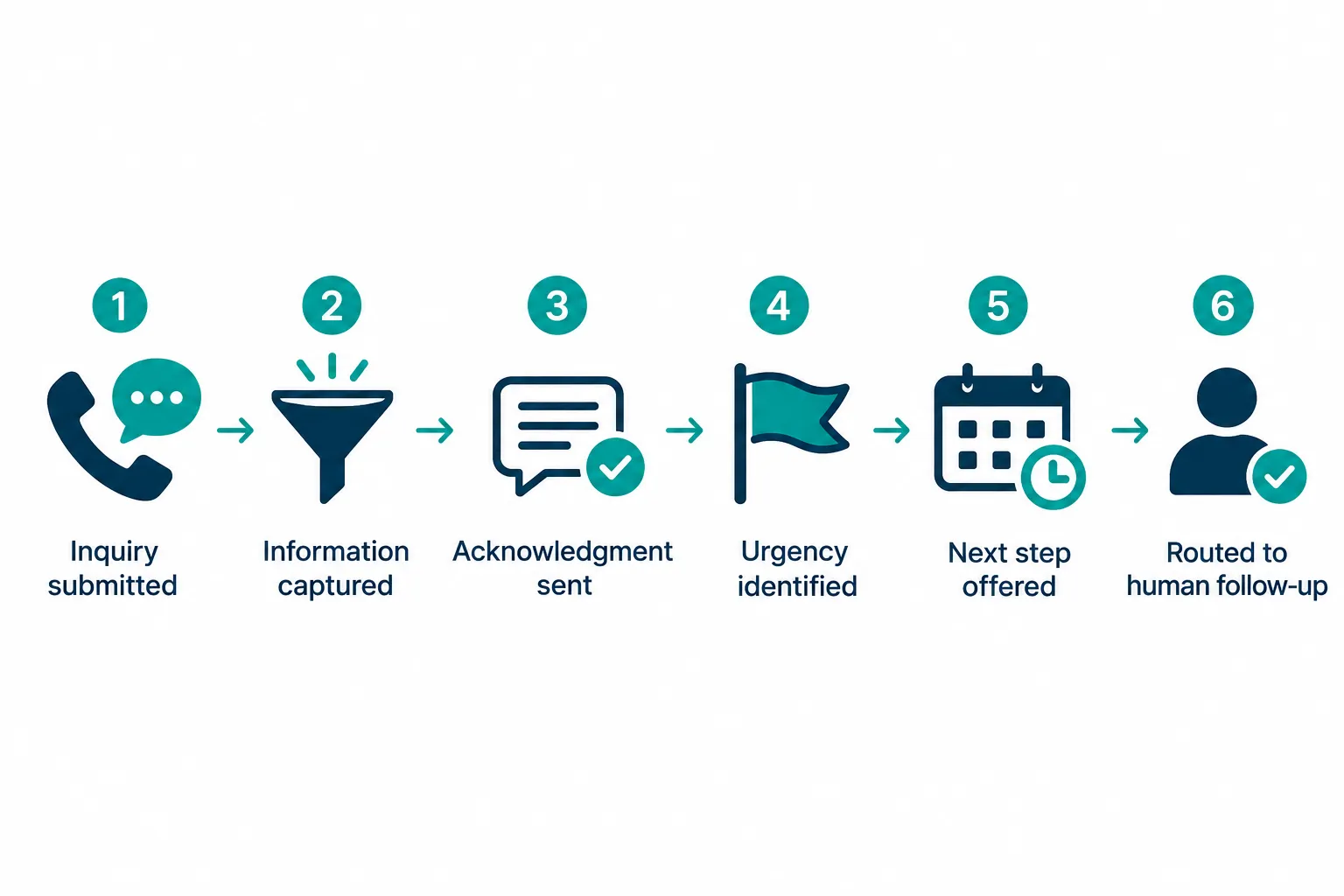
A realistic 24/7 lead response workflow follows six steps, and every step should happen without a human awake at the wheel. Here’s what that looks like in practice:
- A prospect submits a form, sends a text, or calls after hours.
- The system captures the name, contact details, and reason for reaching out.
- The prospect receives an acknowledgment that sets an honest expectation, such as “We’ve received your request and will respond by 9 a.m.”
- The system flags urgency based on keywords or answers to a short set of questions.
- The prospect is offered a next step: request a callback, book an appointment, or get an immediate answer to a common question.
- The inquiry lands in a queue, sorted by urgency, for a real person to follow up according to the business’s actual hours.
This is the structure SalesHubHQ builds for clients: a complete done-for-you system, ready from day one, with no tech knowledge required to run it.
How much does 24/7 lead response cost
Costs vary widely depending on whether you build it piece by piece or use one connected platform. Hiring overnight staff costs far more than automated capture and routing, which is why most small businesses choose software over bodies.
Rough cost tiers to consider:
- DIY with separate tools: a form builder, a chatbot, a CRM, and a booking tool bought individually, often with monthly fees for each and time spent connecting them.
- All-in-one platform: one monthly cost that bundles website lead capture, CRM, AI-assisted communication, and booking.
- Live after-hours staff or answering service: the highest ongoing cost, usually billed per call or per hour.
Common mistake: businesses buy three or four disconnected tools, thinking it’s cheaper, then spend more time (and money) trying to make them talk to each other than they would have spent on one unified system.
Does responding to leads faster actually increase sales
Yes. Multiple studies on lead response timing, including research published by the Harvard Business Review (2011) on contact and qualification rates, found that odds of qualifying a lead drop sharply the longer a company waits to respond. While exact numbers vary by industry, the direction is consistent: faster first contact correlates with higher conversion.
What this means practically:
- A lead that sits untouched overnight is far more likely to contact a competitor.
- Even an automated acknowledgment, which isn’t a full sales conversation, keeps the prospect engaged until a human can follow up.
- Speed matters most for inquiries with clear intent, like a quote request, versus general browsing.
What happens if you don’t respond to leads quickly
If you don’t respond quickly, prospects assume you’re unavailable, uninterested, or already busy with other customers, and they move to a competitor. This is especially true for home service and B2B inquiries where the buyer has already compared a few options.
Real consequences include:
- Lost deals to competitors who replied first, even if your service is better.
- Wasted ad spend, since every unanswered lead is money spent generating an inquiry that went nowhere.
- A reputation for being hard to reach, which spreads through reviews and referrals.
24/7 lead response vs. hiring an in-house sales team
A 24/7 lead response system handles the first touch and routing; an in-house sales team still closes the deal. These aren’t competing solutions, they work together, but one costs a fraction of the other.
| Factor | 24/7 lead response system | In-house overnight sales team |
|---|
| Cost | Software subscription | Salaries, benefits, training |
| Coverage | Always on, consistent | Limited by shift schedules |
| Scalability | Easy to adjust | Requires hiring/firing |
| Personal touch | Good for first contact | Best for complex conversations |
Choose a system over new hires if: your inquiry volume doesn’t justify a full-time overnight role, which is true for most businesses under $20 million in revenue.
Can small businesses afford 24/7 lead response
Yes, and for most small businesses, automation is the only realistic way to offer after-hours customer service without blowing the budget. A single connected platform typically costs less per month than one part-time employee.
This is exactly the gap we built SalesHubHQ to close. Instead of stitching together a website, a chatbot, a CRM, and a scheduling tool, we build the website and content, set up AI-powered lead capture, and create automated follow-up systems, all inside one all-in-one platform. You get a free smart website built for you, systems that actually work, and a predictable growth system without hiring anyone new.
Best tools for automating lead response
The best tools combine capture, conversation, and scheduling in one place instead of forcing you to manage separate logins and integrations. Look for a platform that connects your website, CRM, texting, and calendar, so a lead captured at midnight automatically becomes a scheduled appointment by morning.
What to look for:
- Native website forms and chat, not a bolted-on plugin.
- Built-in CRM so leads don’t get lost between tools.
- Automated text and email follow-up sequences.
- Appointment booking tied directly to lead records.
- Reporting that shows where leads come from and how fast they’re contacted.
How do you respond to leads at night without a team
You respond at night by letting automation handle the first reply, then having a real person follow up during actual working hours or an on-call rotation. The prospect doesn’t need an instant human; they need confirmation that they were heard.
A simple setup looks like this:
- Website chat and forms stay active 24 hours a day.
- An automated text or email confirms receipt within seconds.
- A short set of questions identifies whether the inquiry is urgent.
- Non-urgent leads get a message like “We’ll follow up by 9 a.m.”
- Urgent leads, if your business has them, trigger a call-forwarding rule to an on-call person.
How quickly should you respond to a new lead
Aim to send an automated acknowledgment within minutes and a human follow-up within one business hour whenever possible. For inquiries submitted outside business hours, the acknowledgment should set a specific, honest time for the human response, not a vague “soon.”
Common mistake: setting the same expectation for every lead type. A pricing question and an emergency service call need different response windows, and your system should treat them differently.
Is 24/7 lead response worth it for B2B
It’s worth it for B2B companies whenever buyers research and reach out outside typical 9-to-5 hours, which is common for decision-makers juggling full calendars. B2B inquiries often involve higher deal values, so losing one lead to slow response costs more than the system itself.
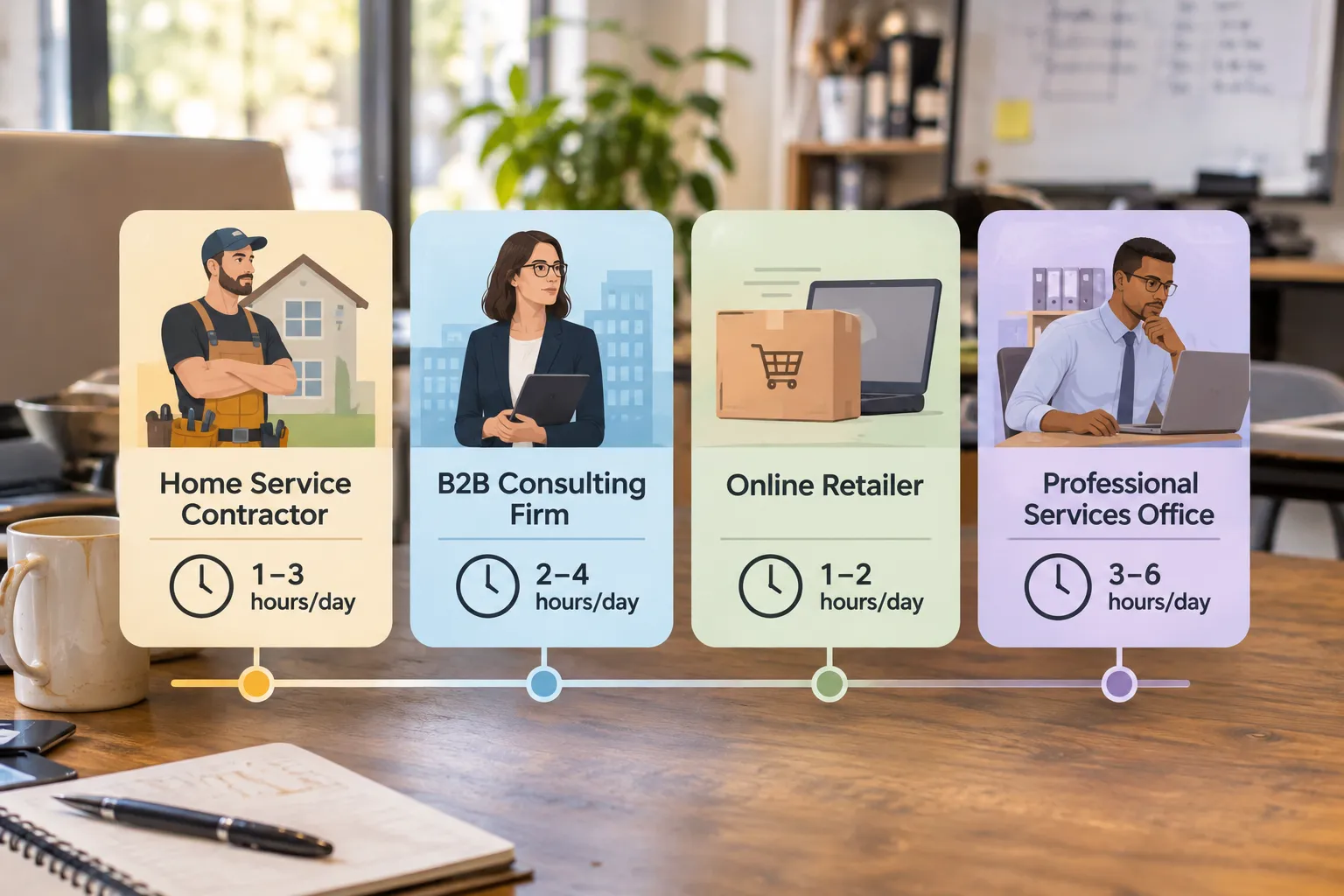
Signs it’s worth it for your B2B company:
- Your buyers include executives who work late or on weekends.
- Your sales cycle is long, so early engagement matters.
- Competitors in your space respond fast, and you’ve lost deals to speed before.
Can you automate lead response without losing the personal touch
Yes, if the automation is honest about what it is and hands off to a real person at the right moment. The mistake isn’t using automation, it’s pretending a bot is a person or promising something the business can’t deliver.
Ways to keep it personal:
- Use the prospect’s name and specific details from their inquiry in automated replies.
- Be transparent: “Our assistant will help you now, and a team member will follow up tomorrow.”
- Make the handoff to a human feel seamless, not like starting over.
Common mistakes businesses make with lead response timing
The most common mistake is promising something the business can’t deliver, like “we’ll call you back in 5 minutes” when no one is actually available. This breaks trust faster than a longer, honest wait time.
Other frequent mistakes:
- Treating every lead the same regardless of urgency.
- Forgetting to update automated messages for holidays and closures.
- Letting leads sit in an inbox with no routing rule at all.
- Using a chatbot that gives inaccurate information about pricing or services.
Do you really need 24/7 lead response or is business hours enough
Not every business needs full round-the-clock coverage; many only need reliable after-hours capture with a next-morning follow-up promise. The right choice depends on how your customers behave and how urgent their needs typically are.
- Choose full 24/7 coverage if: you handle emergencies (plumbing, HVAC, legal urgent matters) or serve customers across multiple time zones.
- A simpler after-hours queue is enough if: your inquiries are mostly research-stage and can wait until the next business day without losing the deal.
How to handle leads across multiple time zones
Handle multi-time-zone leads by time-stamping every inquiry in the prospect’s local time and routing based on actual business hours in that region, not your own. This avoids the common error of promising a callback “within the hour” when it’s actually midnight for the person who reached out.
Steps to get this right:
- Capture the prospect’s time zone automatically from their location or ask directly.
- Set acknowledgment messages to reference their local time, not yours.
- Build routing rules so leads from different regions reach the right follow-up window.
When round-the-clock coverage makes sense and when it doesn’t
Round-the-clock coverage makes sense for emergency services, multi-region companies, and high-volume inquiry businesses. It’s usually unnecessary for low-volume, appointment-based businesses where a next-business-day promise works fine.
Quick example: a roofing company that handles storm damage calls needs real urgency routing. A bookkeeping firm with a handful of weekly inquiries probably just needs a solid next-morning follow-up process.