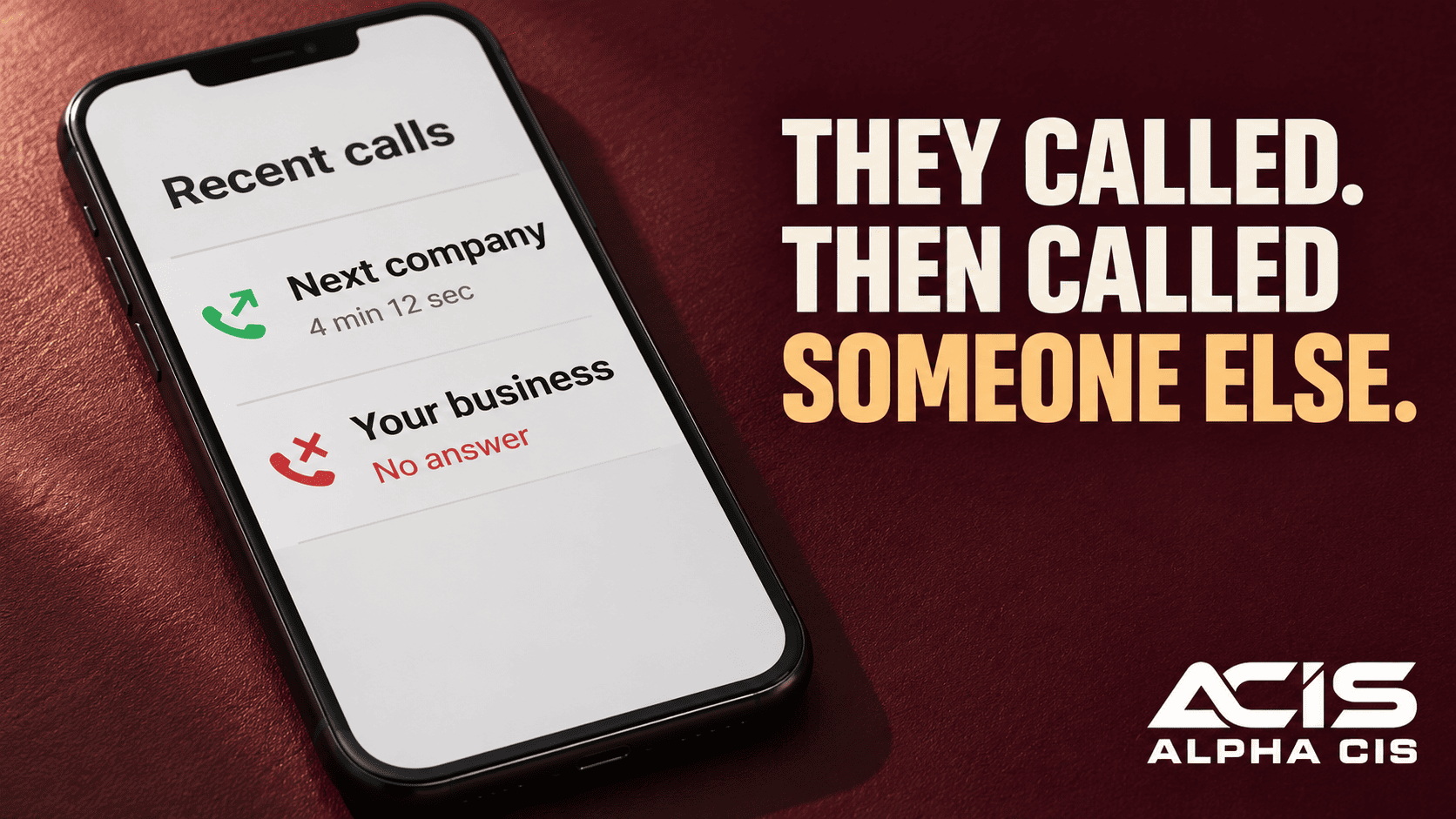
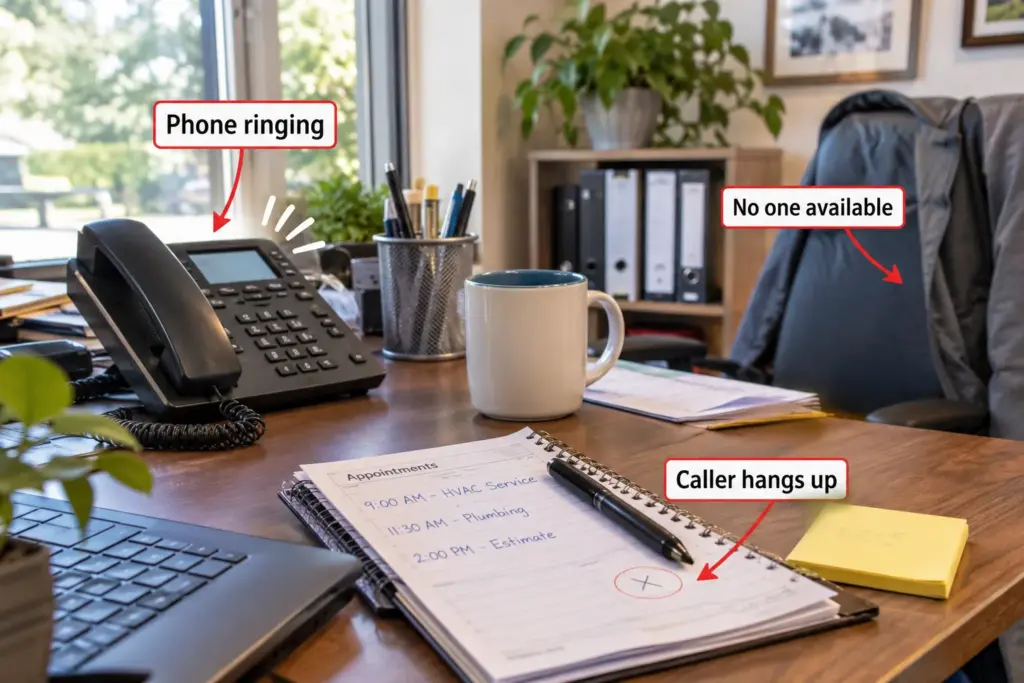
A phone rings at a small plumbing company on a Tuesday afternoon. Everyone is on a job. The call goes to voicemail. The caller doesn’t leave a message. They call the next company on their search results instead. The plumbing company never knows the call happened, never knows what it was about, and never knows they lost a customer. That’s the quiet problem at the center of missed calls business losses: you can’t fix what you can’t see.
This article walks through why calls get missed, how to tell a missed call from a lost sale, and a practical way to put a dollar figure on the problem. We’ll also cover what actually works to fix it.
Why are we missing so many calls?
Businesses miss calls mainly because the people who could answer are busy serving other customers, not because no one cares about new business. It’s a staffing and workflow problem more than an effort problem.
Common reasons calls go unanswered:
- Existing customers take priority. Your team is on the phone or in person with someone who already pays you, so the new caller waits.
- Busy periods cluster calls together. Lunch rushes, Monday mornings, and seasonal peaks create spikes no one staffs for.
- Limited staffing. Small teams can’t have someone glued to the phone all day.
- After-hours timing. A large share of inquiries come in evenings and weekends when offices are closed.
- Unclear ownership. If everyone assumes “someone else will get it,” no one does.
Decision rule: if your missed-call rate spikes at specific hours or days, the fix is scheduling and routing. If it’s spread evenly throughout the day, the fix is usually a system problem, not a staffing problem.
What percentage of calls do businesses actually miss?
There’s no single universal percentage, because missed-call rates depend heavily on staffing, call volume, and business type. Rather than relying on an unverified industry-wide number, track your own call logs for 30 days and calculate your actual rate: unanswered calls divided by total inbound calls.
A simple way to start:
- Pull call logs from your phone system or VoIP provider.
- Count total inbound calls for the month.
- Count how many went to voicemail or rang out unanswered.
- Divide missed by total to get your actual missed-call rate.
Common mistake: counting only calls that reach voicemail. Many phone systems also show “no answer” calls that never triggered voicemail at all. Include both.
How much revenue are we losing from missed calls?
You estimate lost revenue by narrowing missed calls down through a funnel: real inquiries, qualified opportunities, and closed customers, then multiplying by customer value. This gives a defensible estimate, not a guarantee.
Here’s the funnel, step by step:
- Total missed calls, pulled from your phone system logs.
- Genuine inquiry rate, the percentage of missed calls that were real potential customers, not spam or wrong numbers.
- Qualification rate, the percentage of genuine inquiries that match what you sell and could realistically become customers.
- Close rate, the percentage of qualified opportunities that would have become paying customers if answered.
- Average customer value, what a typical customer is worth to you, either per transaction or over their full relationship with your business.
Hypothetical calculation (illustrative only):
Say a home services business misses 150 calls a month. If 60% are genuine inquiries (90 calls), and 50% of those are qualified (45 opportunities), and the business normally closes 30% of qualified opportunities (about 13 to 14 customers), and the average customer is worth $450, the estimated monthly loss is roughly $6,000.
This is an estimate built from assumptions you plug in yourself. Your actual numbers depend on your industry, your pricing, and how good your team is at closing calls that do get answered. Run the math with your own figures before you trust any number.
What’s the average cost of one missed customer call?
The cost of one missed call equals your close rate multiplied by your average customer value, applied only to calls that were genuine, qualified inquiries. A missed call from a telemarketer costs you nothing. A missed call from a ready-to-book customer can cost you hundreds or thousands of dollars.
Quick example using the numbers above: with a 30% close rate and a $450 average customer value, each qualified missed call costs roughly $135 in expected revenue. Multiply that by how many qualified calls you miss per month to see your real exposure.
How do missed calls affect customer satisfaction and retention?
Missed calls hurt customer experience because most callers interpret “no answer” as “this business can’t help me right now,” and they move on to a competitor. Responsiveness is one of the biggest factors in whether a prospect becomes a customer, especially for urgent needs like home repairs or legal questions.
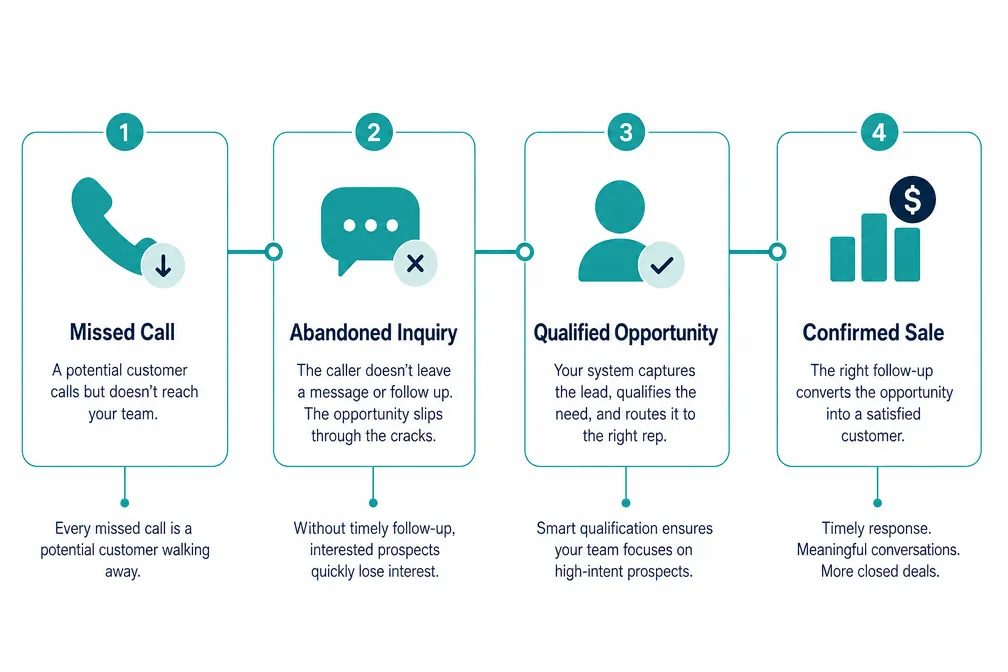
What tends to happen when a call goes unanswered:
- The caller tries a competitor within minutes, especially for urgent service needs.
- Existing customers feel deprioritized if they can never get through either.
- Trust erodes over repeated missed calls, even if the business eventually calls back.
Edge case: for high-consideration purchases (like B2B services with longer sales cycles), a missed call is less fatal because buyers expect some delay. For urgent, local, or emergency services, a missed call is often an instant loss.
Which industries lose the most money from missed calls?
Industries with urgent, time-sensitive, or appointment-driven demand tend to lose the most from missed calls business failures. That includes home services, medical and dental practices, legal consultations, auto repair, and property management.
These industries share a pattern: the customer has an immediate need, multiple competitors are one search away, and the first company to respond often wins the business. B2B service providers lose less per missed call on average, but the deal sizes are often larger, so the dollar impact per lost inquiry can still be significant.
Is it worth hiring more staff just to answer phones?
Hiring more staff only makes sense if call volume is consistently high enough to justify a full-time or part-time role, and if the missed calls are concentrated enough that a dedicated person would meaningfully reduce them. For many small businesses, the volume doesn’t justify a new hire.
Before hiring, ask:
- Are missed calls clustered at predictable times, or random all day?
- Would a part-time answering service or rotating schedule solve it cheaper?
- Is the real issue call volume, or is it that no one owns the responsibility?
Choose hiring if: your call volume is high, steady, and growing, and existing staff are stretched too thin to ever catch up.
Choose an alternative if: missed calls happen in short bursts, after hours, or inconsistently. In that case, a system fix usually costs less and works faster than a new hire.